
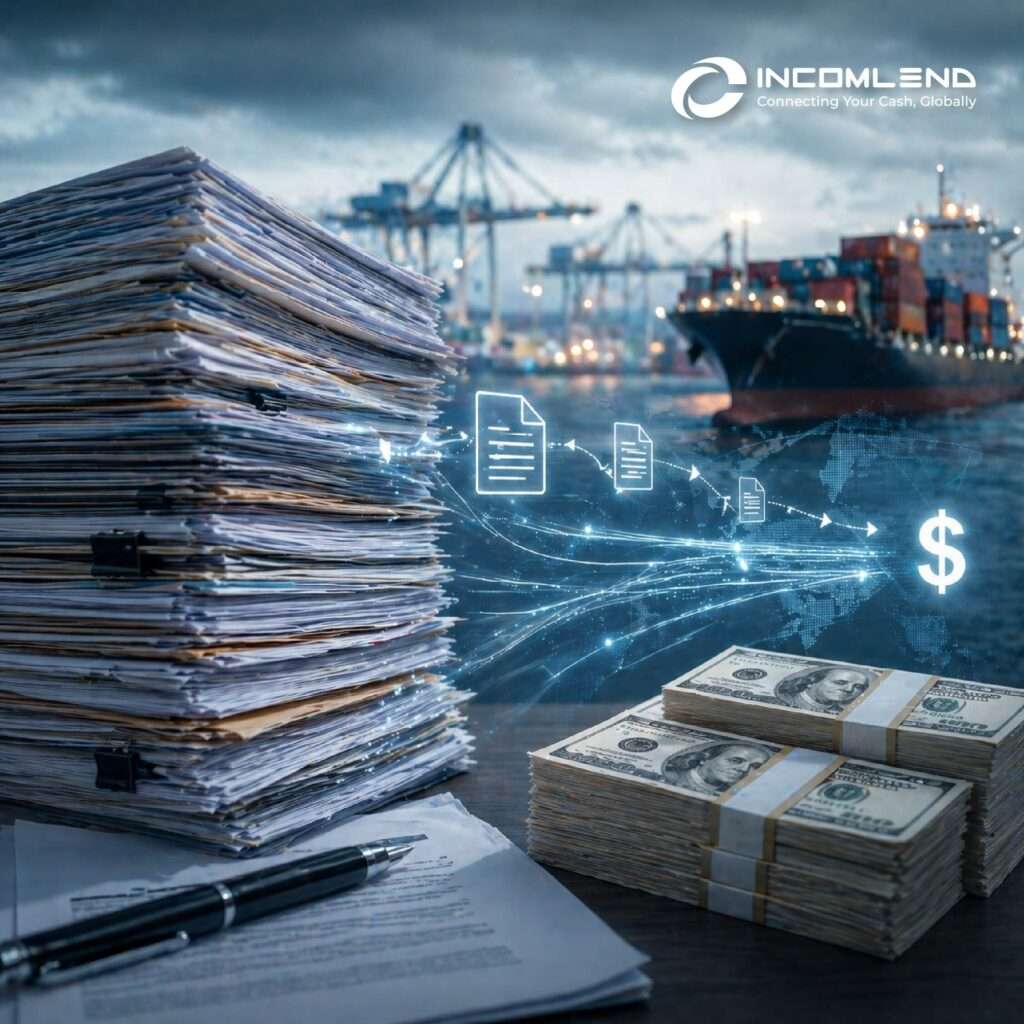
For an industry that finances trillions of dollars of global trade every year, trade finance remains surprisingly dependent on paper.
Bills of lading are couriered across continents. Original documents are physically stamped, signed and transferred. Financing decisions still depend on document packages moving between exporters, importers, banks, insurers, freight forwarders and customs authorities.
This creates a paradox. Global supply chains have become faster, more data-driven and increasingly fragmented. Yet many trade finance processes still rely on infrastructure that would be familiar decades ago.
The consequences are not merely operational inconvenience. They directly affect liquidity, working capital and risk exposure for businesses engaged in international trade.
The scale of the problem
Global trade reached approximately $35 trillion in 2025, according to UNCTAD. Yet much of the supporting documentation infrastructure remains heavily manual.
The shipping industry illustrates the issue clearly.
According to Digital Container Shipping Association, only around 11% of bills of lading were issued electronically in 2025. The remaining majority still relied on paper documentation.
That matters because the bill of lading is not simply a shipping document. It serves several critical functions simultaneously:
- Proof of shipment
- Evidence of ownership
- Document of title
- Trigger for payment and financing
When the document itself moves slowly, the entire transaction slows with it.
For businesses operating on tight liquidity cycles, these delays can become costly.
Why paper remains deeply embedded in trade finance
The persistence of paper is often misunderstood as a technological issue. In reality, the main barriers are legal and operational.
Trade finance depends on legal enforceability across multiple jurisdictions. A digital document only works if every participant in the transaction recognizes its legal validity.
That includes:
- Exporters
- Importers
- Banks
- Insurers
- Shipping companies
- Customs authorities
- Courts and regulators
A single transaction may involve counterparties across several legal systems. If one jurisdiction does not recognize a digital transferable document, participants frequently revert to paper for legal certainty.
This is why digitisation in trade progresses more slowly than many expected.
The missing foundation: universal legal recognition
One of the most important developments in recent years has been the push toward legal frameworks for electronic transferable records.
The most widely referenced framework is the UNCITRAL Model Law on Electronic Transferable Records, commonly known as MLETR.
MLETR aims to give electronic trade documents the same legal standing as paper originals.
Progress is visible:
- The UK implemented the Electronic Trade Documents Act in 2023
- France has advanced electronic trade documentation reforms
- Singapore and several Gulf jurisdictions are progressing toward broader digital trade frameworks
According to industry estimates referenced by logistics and trade bodies, more than 60% of global exports now originate from jurisdictions aligned with or moving toward MLETR-style frameworks.
This is meaningful progress. It still falls short of universal adoption.
For multinational traders, inconsistency across jurisdictions remains a major obstacle.
The direct impact on cash flow
Paper-heavy trade processes affect cash flow in several ways.
1. Slower release of goods
Physical documents often need to arrive before cargo can be released. Delays in courier delivery or document discrepancies can extend storage time and demurrage costs.
2. Delayed financing
Trade finance facilities often depend on original document presentation before funds can be disbursed.
A financing approval may technically be completed, yet funds remain pending because document packages are still in transit.
3. Longer cash conversion cycles
When payments and financing are delayed by documentation bottlenecks, businesses carry higher working capital requirements.
This becomes particularly problematic during periods of:
- Freight volatility
- Higher interest rates
- Longer shipping routes
- Supply chain disruptions
4. Higher operational risk
Manual document handling increases the probability of:
- Errors
- Fraud
- Duplicate financing attempts
- Lost documentation
- Compliance discrepancies
According to estimates from the International Chamber of Commerce, paper documentation contributes significantly to processing inefficiencies and trade finance friction globally.
Why digitalisation remains fragmented
Technology itself is no longer the main limitation.
The market already has:
- Electronic bills of lading
- Digital document platforms
- Blockchain-based trade systems
- Automated compliance tools
- Digital identity verification solutions
The deeper challenge is interoperability.
Many platforms operate as isolated ecosystems. Participants in one system may not seamlessly connect with another.
Trade transactions involve multiple stakeholders, each with their own systems, compliance procedures and operational preferences. Coordinating all parties around a single standard remains difficult.
This fragmentation creates a recurring pattern across the industry:
- Successful pilot projects
- Limited large-scale adoption
- Continued reliance on hybrid paper-digital workflows
As a result, many businesses continue operating with partial digitisation rather than full digital execution.
Why full digitisation will take longer than expected
Trade finance differs from consumer payments or retail banking because the transaction itself is structurally more complex.
A commodity trade transaction may involve:
- Multiple jurisdictions
- Maritime law
- Insurance claims
- Inspection certificates
- Sanctions screening
- Financing structures
- Transfer of title
Each layer requires legal certainty.
This explains why adoption remains gradual even though the economic incentive for digitisation is strong.
The industry is moving toward digitalisation. The transition simply requires coordination between legal systems, financial institutions, logistics providers and regulators.
What businesses can do today
Waiting for full industry transformation is not a practical strategy.
Companies can already reduce friction and improve liquidity by adapting their operational approach.
1. Prioritize digitally advanced trade corridors
Some jurisdictions are progressing faster than others in recognizing electronic documentation. Businesses operating in these corridors may benefit from faster execution and reduced administrative delays.
2. Reduce document complexity where possible
Simplifying transaction structures and document requirements can reduce processing bottlenecks and discrepancy risk.
3. Work with financing partners that understand operational risk
Trade finance increasingly requires operational expertise, not simply capital deployment.
Understanding shipping flows, documentation chains and counterparty coordination has become a competitive advantage.
4. Integrate financing strategy with logistics planning
Cash flow optimisation increasingly depends on how financing and logistics interact.
The timing of shipment, document transfer and payment release now has direct working capital implications.
The next phase of trade finance
The future of trade finance will likely be hybrid for years to come.
Digital documentation adoption will continue to expand. Stablecoins and faster payment rails may improve settlement speed. AI-driven compliance and verification tools will improve operational efficiency.
At the same time, legal enforceability and risk management will remain central.
The most effective trade finance ecosystems will combine:
- Legally recognized digital documents
- Faster payment infrastructure
- Interoperable systems
- Strong operational controls
- Flexible financing structures
The objective is not simply digitisation. It is reducing friction across the full transaction lifecycle.
Conclusion
Trade finance still runs on paper because global trade depends on legal certainty, coordinated infrastructure and enforceable ownership transfer across jurisdictions.
Technology alone does not solve these requirements.
For importers, exporters and commodity traders, the impact is immediate: slower payments, delayed financing, higher working capital needs and increased operational friction.
Digitalisation is progressing, but unevenly. The businesses that adapt early to evolving trade infrastructure will likely benefit from faster execution, stronger liquidity management and more resilient supply chain financing.